Violator
Content warning: gore

I was a very morose child. I liked sleeping under my bed, with pillows arranged under the covers so that my parents would not notice I was missing. That was when I wasn’t sleeping in my closet. When my mother gifted me my first camera, nothing pleased me quite like taking pictures of myself pretending to be dead. I showed them to my parents, they were of course very concerned. When I developed an interest in death metal, my parents frequently remarked about their discomfort at me listening to this music.
I remember my mother saying that it made her uncomfortable, which struck me as a bit of an odd critique. It’s difficult to imagine death metal about… well. Something else. The sound of a death metal vocalist doing something other than grunting or growling is just not quite right.
When I picked up an interest in film, a germ that dates all the way back to my younger days of using my parents’ missile launcher-shaped VHS recorder with action figures, there was a critical moment where I saw Sam Raimi’s early films—Evil Dead 1 and 2—and saw something absolutely brilliant in them. A punk ethos, although not explicit, of making a film happen, hell or high water. It looks like it, too. The continuity between Evil Dead 1 and its sequel is not really obvious at first watch, and that’s because there essentially isn’t one. Similarly, the films have cartoon-like appeals. It’s gory, sure, but it’s not the sophisticated torture porn of later decades. There’s a slapstick component to it that prevents any of the horror elements from being taken a bit too seriously. The puppetry was also a massive influence on my impressionable mind. I’ve spent a lot of time reading about the formal construction of creatures, of make-up done to look like horrific wounds; that stuff is catnip to me.
These days, I spend a lot of time reading about things which are (or at least adjacent to) horror. I know that in some literary circles, so called “splatterpunk” is having a moment. Similarly, death metal—specifically brutal death metal—seems to be having a moment in the American cultural landscape that I never really could have foreseen in the lean years of the 2000s. When it comes to film, horror seems to be pretty healthy as well. Robert Eggers is a darling director, Zach Cregger has transitioned from being a joke-writer for a sketch comedy group into becoming a horror director of some renown.
By all conceivable metrics, it seems like there is a desire for horror that is simply not being met. Why would people be so hungry for horror?
Even though I spend a lot of time interacting with the macabre, I want to stress that I am not a dour person. Of course, I have a particular kind of humor, but I am not a malevolent person. I certainly think of myself as a creep, but not an evil one. I like to chat, I like to flirt with strangers. I love cooking for other people (of course the pleasure there is all mine). Despite stating all of this, I do not take some sort of fetishistic pride in it as a seeming contradiction; I do not believe it behaviorally to be a crazy dichotomy. In fact, I think it is very normal.
What horror is very good at aesthetically is preventing calcification. The oftentimes grim subject matter for metal is an almost perfect compliment for its incredibly lively and kinetic rhythms, even when it’s the glacial movement of doom metal. Despite its almost laser focus on death and suffering, it’s hard to imagine something more vivacious. This allows for wonderful mutations that delve into the contours of horror, such as a black metal band deploying shimmering guitar tones to explore the bittersweet notes of an oncoming spring.
Of course, horror is not ordinarily such a flowery subject. When I say that horror prevents calcification, I think back to being a grim child, in a way of life that just struck me as natural. I imagine how my mother must have felt when her young son, one that she believes is a creative of course (what else would explain this behavior), goes days and days without saying a single word, just to proudly show you a picture of himself, deceased. I think it is very funny, but when I told her that I was going to have a film debut at the Manhattan Museum of Modern Art, she released this sigh which must have been incubating in her lungs for as long as I have been alive. A thankful utterance—thank You, God—that my disturbing child has decided to violate someone else for a change.
To say that horror prevents calcification is to phrase this—that horror answers the desire to be violated—in a much nicer way. There is something that occurs to me about interacting with others or the world, a way in which deviations in day to day life are made impossible, where your models for other people are so ironclad that nothing surprises you anymore. Nothing reorders your position in relationship to the world outside of yourself. You know, with certainty, how another person behaves, how every story ends; you’ve met every type of man or woman. In a sense, the world is made duller because it has ceased to be real. Vulnerability has nothing to do with the rigid malleability of your physical bones, and everything to do with talking about your feelings to another. To have your control absolutely taken from you, to be rendered a small-minded mess incapable of making sense of the outside world any longer; to have the control of your senses totally lost to the presence of something else, something inconceivable, something which may not even be human at the end of the day—you, more than likely, have no idea how much you want to be violated.
Years ago, I acquired my first Jewish friend. Those did not really exist where I came from. It has been quite the learning experience—one of the earliest was her introducing me to a dish called noodle kugel. Sweet noodles, I had never heard of such a thing. Of course I tried it. Unfortunately, I had no idea what I was in for. Years prior, I had broken teeth in a mosh pit and simply left them that way. There would be some occasional pain, but nothing I couldn’t tolerate seeing as how I had no health nor dental insurance for the longest time. That night, as I went to bed, they hurt more than usual.
So badly, in fact, that I began crying. An adult male—crying from tooth pain. No water helped, no salt gurgles, nothing would dull it. Eventually, I wound up going to the emergency room. The whole time, the pain was getting worse and worse. Although I wasn’t sobbing, nothing could stop tears from leaking through the corners of my eyes. I have broken bones, I have had my skull stapled together, yet I will confidently say this: I have never, in all my life, felt physical pain so overwhelming as I did that night that I had noodle kugel.
Things would spiral downwards still in the emergency room. I am on a bed, waiting, now delirious. I am drooling everywhere, doubled over, tears continuing to douse that paper sheet lining the bed. I cannot sleep, I cannot think, I am being endlessly stabbed in the mouth by something I cannot identify. After six hours, a nurse shows up just to disappear again. Finally, at 5 in the morning, a doctor appears to tell me that I have two broken teeth, both now infected, which will have to be extracted. They gave me a prescription for something called “Halcyon”, which I thought very ironic—it totally disabled my body and made me want to commit suicide.
Later that same day, no sleep at all, I showed up to a dentist office. I sat in a chair and had my mouth stabbed at by a couple of needles which, thankfully, dulled the pain which had tortured me for going on a full day now. The dentist shows back up with some hardware clearly meant for extraction and explains that I will not feel pain, but I will feel pressure. I nodded.
“Pressure” was perhaps the most conservative way to state what I felt. Of course, there was thankfully no pain. What there was—in this “pressure”—was the unmistakable sensation of bone grinding against bone; twisting and sheering in my jaw. Fighting tooth and nail to not be unseated with whatever vice grips he was using to extract them. The first one came out, then the second one. It was uncomfortable, but fortunately, I was conscious for the duration, and therefore more curious about the process than anything else.
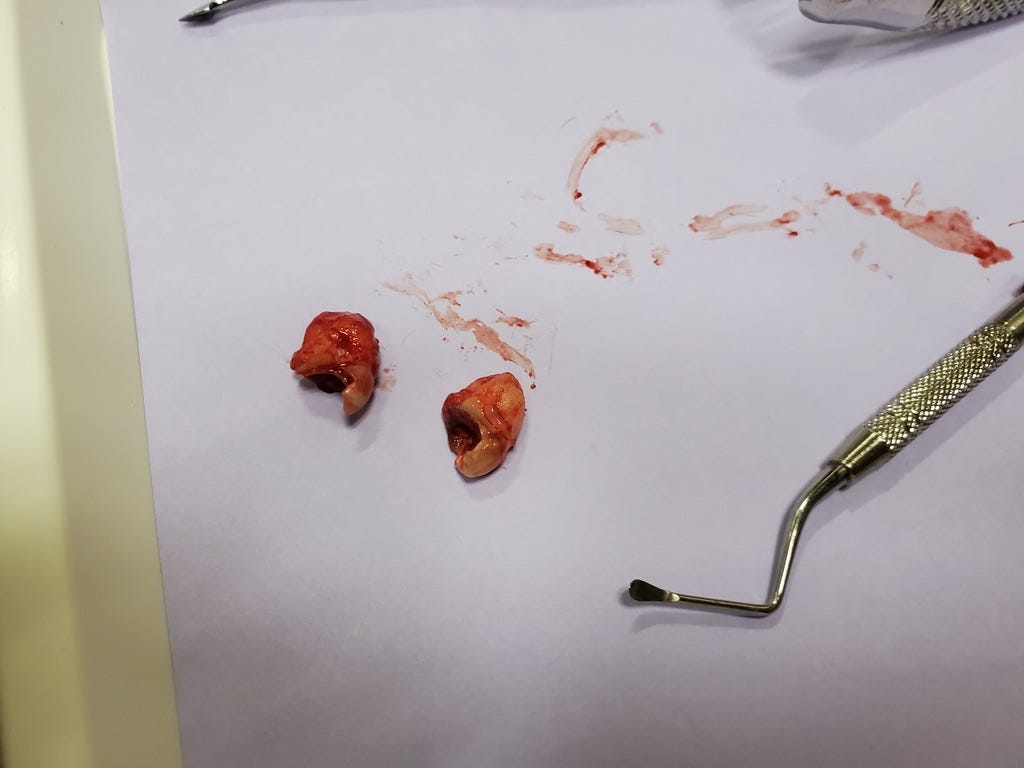
Finally, once both teeth were extracted, I turned my head to the left while the dentist was explaining something about aftercare. I noticed the remains of my teeth there. Totally horrific. They were indeed fractured—for years, I could feel jagged pieces of bone occasionally lacerating the side of my cheeks. I brush and floss regularly, I take care of my teeth; these broken things were my dirty little secret in a way. On the metal table, they were covered in, what I thought, was just an amazing amount of blood. Speaking of, my mouth is also just full of blood. The dentist explains that’s just what the next few days will be like—drooling blood. This is all very metal, I thought.
I asked the doctor if I could take a picture of my teeth, which I did. I’ve attached it below.
I have not had noodle kugel since. I’ve tried my fair share of food which I didn’t quite like, but nothing which had ever injured me so. I wouldn’t say that I fear it more than I’d say I respect it, now.
Actually that’s a lie, I am afraid to try it again. Of course we are still fast friends. I spend a lot of time smiling when we are together. Thankfully the bleeding has long since stopped.